.png)
Adding Retirement Contributions to Your Tax Profile
Your tax profile has a section for retirement contributions, which can reduce your estimated taxable income.
Date of birth — add this first. Flux uses it to determine whether you qualify for catch-up contribution limits (age 50+, or 60–63 for a Solo 401(k)).
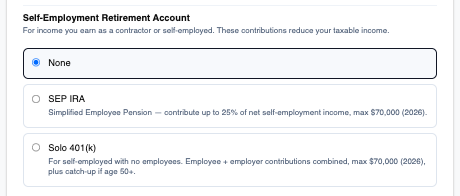
Self-Employment Retirement Account (for 1099/self-employed income only):
- SEP IRA — contribute up to 25% of net self-employment income, capped at $70,000 for 2026.
- Solo 401(k) — for self-employed people with no employees. Combines employee and employer contributions, also capped at $70,000 for 2026, plus a catch-up amount if you're 50+. You can split out how much of your contribution is Roth (after-tax) — only the employee portion can be Roth, and Roth contributions don't reduce this year's estimate (they grow tax-free instead).
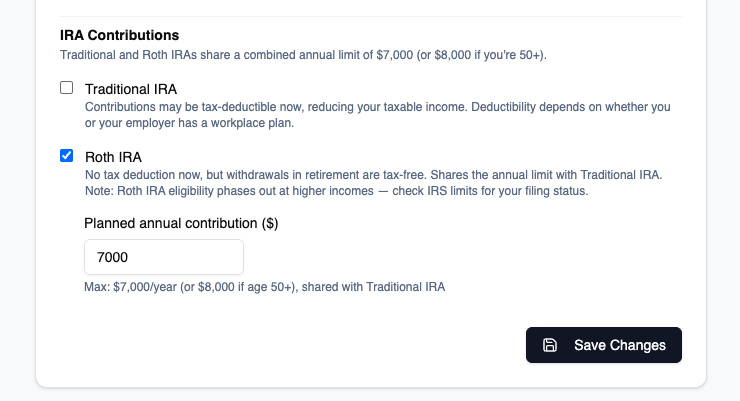
IRA Contributions (anyone can use this section):
- Traditional IRA — may be tax-deductible now. Whether it's deductible depends on if you or your employer offers a workplace retirement plan — this is where the "Employer retirement plan" checkbox on your W-2 sources matters. If you're covered by a plan, the deduction phases out at higher income levels.
- Roth IRA — no deduction now, but tax-free withdrawals in retirement. Roth IRA eligibility itself phases out at higher incomes, separate from the deduction phaseout on Traditional IRA.
- Traditional and Roth IRA share a combined annual limit ($7,000, or $8,000 if you're 50+). Flux enforces these limits rather than just flagging them: if your SEP IRA, Solo 401(k), or combined IRA contributions go over the annual limit (or your Solo 401(k) Roth split exceeds the employee contribution cap), you'll see a red error next to the field and won't be able to save until it's corrected. This applies whether you're filling in your tax profile from the Profile page or during paid account setup.
Any deduction from these sections lowers your taxable income before Flux applies federal brackets, so it's worth keeping this section current if your contributions change during the year.